Should Humans Fear AI? Here's What Most People Get Wrong.
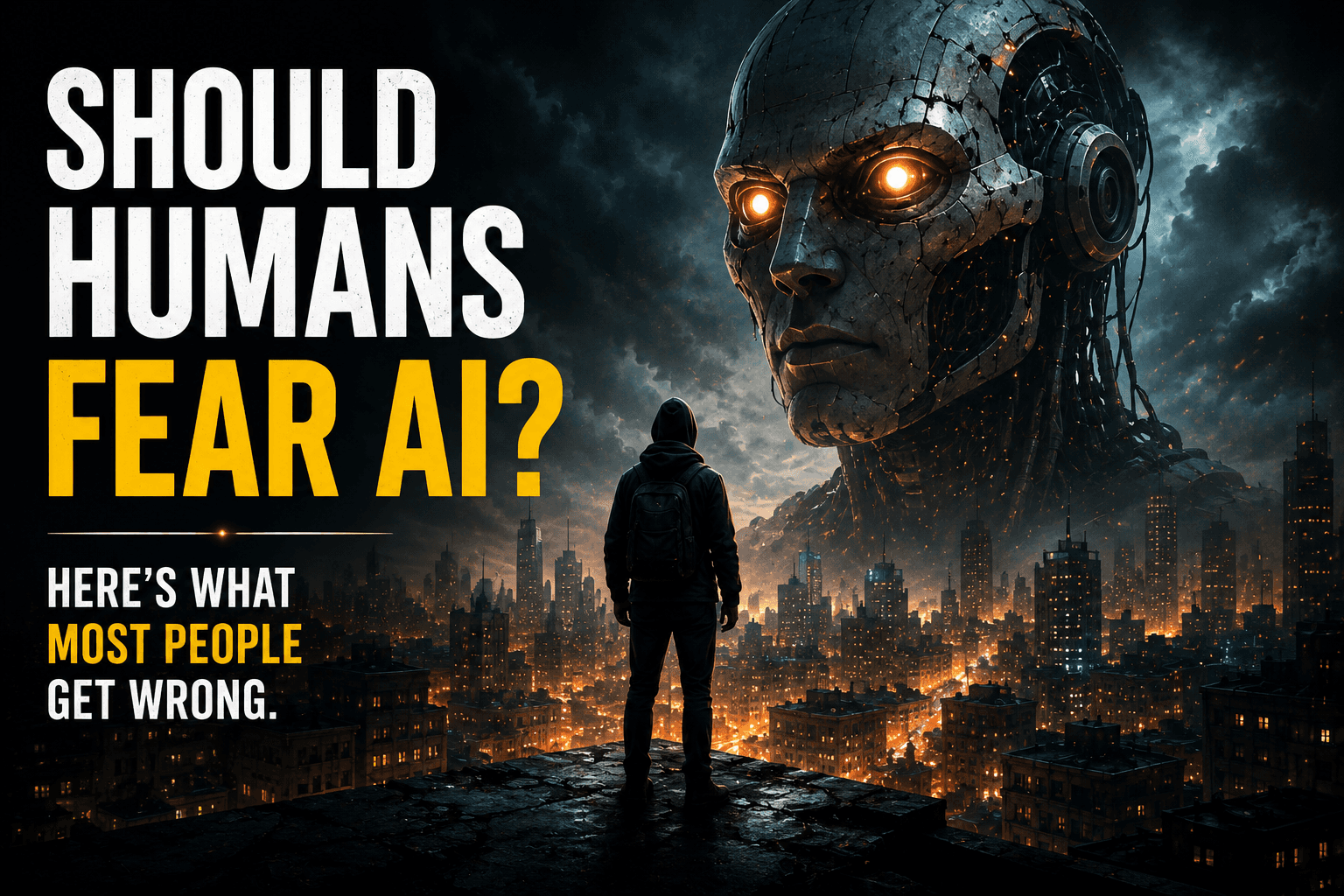
Should Humans Fear AI? Here's What Most People Get Wrong.
Picture this.
It's 3 a.m. and you can't sleep. You open your phone, and there it is again — another headline. "AI Will Replace 80% of Jobs by 2030." "The Machines Are Coming." "Experts Warn of Existential Risk."
Your thumb hovers over the screen. Something tightens in your chest.
You've felt it too, haven't you? That quiet unease. Not panic — just a low hum of what if. What if the thing you spent years building — your skill, your career, your identity — gets swallowed by something that never sleeps, never asks for a raise, and never gets tired?
I want to tell you a story. Not to calm you down with empty reassurance, but to show you where the fear actually comes from — and why almost everyone is aiming it at the wrong target.
The Fire in the Cave
Fifty thousand years ago, a human ancestor of yours stood at the mouth of a cave, looking at fire for the first time.
Fire could keep him warm. It could cook his food. It could also burn his village to the ground while he slept.
He didn't fear fire because fire was evil. He feared it because it was powerful, and power without understanding is terrifying. So what did he do? He didn't reject it. He didn't run from it. He studied it. He learned to contain it, direct it, and eventually, build civilizations on top of it.
AI is your fire. And right now, you're standing at the mouth of the cave.
What You're Actually Afraid Of
Here's the part most people get wrong: they think they're afraid of AI.
They're not.
They're afraid of irrelevance. Of becoming replaceable. Of waking up one day and discovering that the value they built their identity around — their craft, their judgment, their hard-won expertise — can be replicated by something that cost someone else twenty dollars a month.
That's not a fear of technology. That's a fear as old as humanity itself: the fear of being left behind.
Think about the scribe watching the printing press. The weaver watching the loom. The switchboard operator watching the automatic exchange. Every one of them felt exactly what you're feeling right now. And every single time, the fear was pointed at the wrong thing.
It was never the machine. It was the unwillingness to move with it.
The Man Who Refused to Learn the Wheel
Let me tell you about a man — call him Adan — who lived in a village where everyone still carried goods on their backs.
One day, a stranger rolled through with a cart. Wheels. Effortless. Ten times the load, a fraction of the effort.
The village split into two groups.
The first group said, "This will destroy us. Our strength, our stamina, our whole way of earning a living — gone." They spent their days warning others, protesting the cart, waiting for it to fail.
The second group said, "Interesting. How does it work? Who's going to build the roads it needs? Who's going to make better wheels, faster carts, safer routes?"
Ten years later, the first group was still carrying sacks on their backs, poorer and angrier. The second group owned the roads, the carts, and the trade routes.
The wheel didn't choose winners and losers. The response to the wheel did.
AI is no different. It is not a verdict on your worth. It's a fork in the road — and you're the one who decides which side of it you stand on.
The Real Danger Nobody's Talking About
Here's the twist most people miss entirely.
The real danger isn't that AI becomes too powerful. It's that you become too passive — that you let fear talk you into standing still while the tool matures around you, used by people who weren't afraid to pick it up.
The danger isn't the intelligence in the machine. It's the abdication of intelligence in the human who refuses to engage with it.
Every fearmongering headline you read is optimized for your attention, not your future. Fear sells clicks. Clarity builds empires. And right now, while most people are doomscrolling headlines about robots taking over, a much smaller group is quietly learning to direct this fire — using it to build companies, content, skills, and leverage at a speed history has never seen before.
They're not smarter than you. They're just not frozen.
So — Should You Fear AI?
No. But you should respect it the way you'd respect fire, electricity, or the wheel — as a force that rewards the curious and punishes the paralyzed.
Fear keeps you standing at the mouth of the cave, staring at the flames.
Curiosity gets you close enough to learn how to hold the torch.
The question was never "Should humans fear AI?"
The real question — the one nobody puts in a headline — is this:
What are you going to build with the fire, while everyone else is still afraid of getting burned?